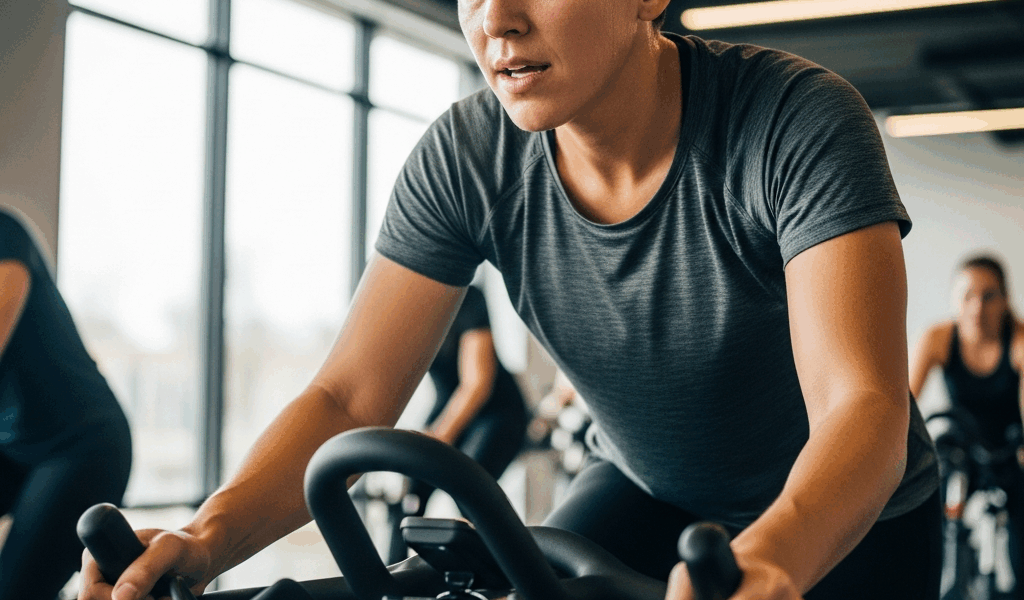
Your First Spin Class — What to Expect and How to Not Die
If you’re searching “first spin class what to expect,” you’re probably sitting at home either very excited or very nervous. Maybe both. I’ve been teaching indoor cycling for going on six years, and I can tell you the same thing I tell every single person who walks into my studio looking like they’ve accidentally wandered into the wrong room — you are going to be fine. You are also going to be more exhausted than you’ve ever been on a stationary bike. Those are both true at the same time. This guide is not sponsored by a studio. I’m not trying to sell you a Peloton membership or get you to book a SoulCycle package. I just want you to walk into that room knowing what’s actually coming, because the honest information is weirdly hard to find.
What to Wear and Bring
Let’s start here because gear questions are the ones I get in my DMs almost every week, and getting this wrong makes your first class genuinely worse than it needs to be.
The Clothing Situation
Wear padded cycling shorts or fitted leggings. That’s it. That’s the rule. The padding matters more than you think — your sit bones are about to spend 45 minutes on a very narrow saddle and they will let you know about it afterward. I’ll talk more about saddle soreness in the recovery section, but good shorts help. Brands like Pearl Izumi and Castelli make dedicated cycling shorts with chamois padding built in; the Pearl Izumi Quest Short runs around $65 and is worth every cent for regular riders. If you’re doing a single first class to test the waters, your regular fitted leggings are fine — just nothing loose or flowy.
No loose fabric. Seriously. Baggy shorts can catch on the seat when you stand, which is both embarrassing and a real tripping hazard when you’re trying to get off the bike post-class on jelly legs.
About shoes. If the studio has clip-in cycling shoes available for rent — usually $3 to $5 — rent them. They lock into the pedals and let you pull up through the pedal stroke instead of just pushing down. The difference in efficiency is significant. But here’s the thing I wish someone had told me before my first class using rented shoes: bring a thin pair of socks you don’t care about. Rental shoes have been on a lot of feet. Also, if you own road cycling shoes with SPD-SL or Look Delta cleats, call the studio first — most spin bikes use the SPD two-bolt system, and the wrong cleat won’t clip in and you’ll just stand there feeling confused while the instructor watches.
If you’re skipping the cycling shoes entirely and using regular sneakers, make sure they have a stiff sole. Running shoes with a lot of cushion and flex aren’t ideal because the soft midsole compresses against the pedal and you lose power transfer. A cross-trainer or a court shoe works better. And please — do not break in new shoes at a spin class. I made this mistake during a training certification weekend and had blisters on both heels by hour two. Learn from my suffering.
What to Actually Pack
- Water bottle — not a small one. A full 32 oz minimum. You will sweat more than you expect.
- A small towel for your handlebars and face. Some studios provide them, many don’t.
- An extra hair tie if applicable. One will break. It always breaks.
- A light snack for after — banana, handful of almonds, something with carbs and protein. Don’t eat a full meal beforehand, but don’t show up having fasted since breakfast either.
How to Set Up Your Bike
Probably should have opened with this section, honestly. Bike setup is the single biggest thing that separates a comfortable class from one that wrecks your knees. Bad setup doesn’t just feel wrong — it can actually hurt you over time, and nobody wants a knee injury from a fitness class.
Seat Height
Stand next to the bike. Find your hip bone — that pointy bit on the front of your pelvis. Set the seat so the top of the seat pad is level with that point. When you clip in or put your feet on the pedals, you want a very slight bend in your knee at the bottom of the pedal stroke, not a full locked-out extension and definitely not a deep bend where you’re practically squatting.
A seat that’s too low puts enormous strain on your kneecap. Too high and you’ll rock side to side trying to reach the bottom of each stroke, which strains your hips and lower back. Get this right before you do anything else.
Handlebar Height
For your first class, set the handlebars at the same height as your seat or slightly higher. This is more upright than what experienced cyclists use, and that’s fine. The more upright position takes pressure off your lower back and lets you focus on the legs rather than on trying to hold yourself up with your core when your core isn’t used to it yet. You can drop the bars over time as you build strength.
Fore-Aft Seat Position
Slide the seat forward or backward so that when your pedals are at the 3 o’clock and 9 o’clock positions — horizontal — your front knee is directly over your front foot. That’s the safe zone for your patella. Most beginners never adjust this and just take whatever position the last person left, which is a mistake.
Ask the instructor to check your setup before class. Every good instructor expects this from first-timers. It takes two minutes and it matters. I’ve never once been annoyed when a new rider asks me to look at their bike — I’m annoyed when they don’t ask and then spend 45 minutes in a position that’s going to make them never come back.
What the Class Is Actually Like
A standard spin class runs 45 to 60 minutes. Most first-timer classes or regular group rides follow the same rough structure: a warm-up, a main set with intervals and climbs, and a cool-down. Let me walk you through what that actually feels like in the room.
The First Ten Minutes
Warm-up. Easy pace, low resistance. The instructor will cue cadence — that’s pedal speed, usually expressed in RPM. You won’t have a gauge on most studio bikes, so the instructor will describe it as “slow jog pace” or “brisk walk.” Trust the description more than any number.
The music starts loud immediately. That part surprises people. Spin studios are not quiet gyms. The bass will be felt in your chest. This is intentional — the music drives cadence and energy. If you’re sensitive to volume, bring earplugs. No judgment.
The Main Set
This is where it gets hard. Intervals mean you’re alternating between high effort and recovery. Climbs mean heavy resistance and slower pedaling, usually while seated or with the instructor leading the class in a standing “run.” The instructor will say things like “add two turns of resistance” or “climb to a seven out of ten effort.”
Here is what I need you to hear: it is completely okay to sit down when the instructor calls a standing run. It is completely okay to lower your resistance when everyone else is grinding up a climb. Nobody in that room is watching you. They are staring at the floor or into the middle distance trying to keep their own legs moving. First-timers think they’ll stick out by sitting down. They won’t. I barely notice from the front of the room, and I’m the one paid to be paying attention.
The Cool-Down
Last five to eight minutes. Easy spinning, some stretching on the bike — forward fold over the handlebars, hip flexor stretch with one foot on the frame. Take this seriously. Don’t rush off the bike the moment class ends. Your heart rate and your legs both need the slow descent.
The Resistance Mistake Every Beginner Makes
This is the section I want tattooed somewhere visible in every spin studio.
Beginners almost universally start with too little resistance. It feels safer. The pedals move easily, the cadence feels controllable, and everything seems fine — until it isn’t. At high cadence with almost no resistance, the flywheel is essentially pulling your legs around rather than the other way around. Your knees start bouncing. The movement becomes uncontrolled and jerky. This is not a good workout and it is genuinely hard on your knee joints. I see this every single class with new riders.
The fix is counterintuitive — more resistance makes the class feel easier to control, not harder. Think about the difference between trying to walk on ice versus walking on pavement. Grip matters. You want the feeling of pushing against something.
Start at a resistance level where the pedals feel like they have weight behind them. Your legs should be driving the pedals — not the other way around. If you feel like the bike is running away with you, add resistance immediately. The instructor will cue resistance changes, but those cues are relative. If they say “add a turn,” and you’re already at zero, add two turns to catch up to a functional baseline.
The opposite mistake — too much resistance — means you’ll grind to a stop trying to keep up with the cadence cues. That’s exhausting in the wrong way and it kills your form. The sweet spot is controlled effort where you feel the burn but you’re still in charge of the pedal stroke. You’ll find it by the second or third class. First class, err on the side of slightly more resistance than you think you need.
One more thing. Never ride with zero resistance. There is a knob that tightens against the flywheel, and on most Schwinn and Keiser studio bikes, turning it all the way counterclockwise gives you almost nothing. Don’t do this. It puts all the load impact directly into your joints with no muscular engagement to absorb it.
After Class Recovery
Dragged out of class by a combination of exhaustion and pride, I once skipped the post-class stretch entirely after my first-ever spin certification ride. I could barely walk down stairs for three days. Do not be me.
The Soreness
Expect DOMS — delayed onset muscle soreness — for two to three days after your first class. It will peak around 48 hours post-ride. Quads, hamstrings, glutes, calves, and sometimes your lower back will all have something to say. This is normal. It means the workout was real.
Stretch immediately after class while your muscles are still warm. Target hamstrings with a standing forward fold or a seated single-leg stretch. Hit your quads with a standing quad pull or a half-kneeling lunge. Hold each for 30 to 45 seconds. Not 10 seconds. Thirty to forty-five.
Saddle Soreness
Let’s be honest about this one because every article dances around it. Your seat bones — the ischial tuberosities, the two points you feel when you sit on a hard surface — are going to be sore after your first class. Maybe the next day, maybe during the second half of class. This is universal. It happens to everyone. It is not a sign that something is wrong with your bike setup or your body.
It goes away after three to four classes as your body adapts to the saddle. Padded shorts help. Chamois cream — a friction-reducing balm designed for cyclists, brands like Chamois Butt’r or DZ Nuts sell tubes for around $15 — helps even more if you’re planning to ride multiple times per week. Apply directly to the skin before riding, not to the shorts.
Hydration
Drink water immediately after class. Then keep drinking for the rest of the day. A 45-minute spin class can result in 16 to 32 oz of sweat loss depending on room temperature and your own physiology. Studios run warm — often 75 to 80°F — because the heat is considered part of the experience. Replace fluids aggressively. If you’re doing an evening class, a small salty snack alongside your water helps replace sodium lost in sweat. Pretzels work. Pickle juice works even better, if you’re brave.
Come back for class two. Class two is easier than class one. Class three is when it starts being fun. That’s not a pitch — it’s just how the adaptation curve actually works, and you deserve to know that before you decide whether to write off the whole thing based on one very sweaty Tuesday.


Leave a Reply