Spin Bike Resistance Not Working — Why It Matters and What You Can Actually Do
Spin bike troubleshooting has gotten complicated with all the generic advice flying around. Turn this knob. Tighten that bolt. Call the manufacturer. None of it accounts for the fact that there are fundamentally different resistance systems out there — and a fix for one does absolutely nothing for the other. As someone who stood over a dead spin bike mid-workout, turning the resistance knob into empty air while sweat dripped onto my garage floor, I learned everything there is to know about this subject. Today, I will share it all with you.
Most articles treat every spin bike like they rolled off the same assembly line. They didn’t. A magnetic resistance failure looks nothing like a friction pad failure. Mixing up the diagnosis costs you an hour — minimum.
What Type of Resistance Does Your Spin Bike Use — Magnetic or Friction
This is the fork in the road. Get this wrong and everything else is wasted effort.
But what is resistance type, exactly? In essence, it’s the mechanical method your bike uses to create pedaling load. But it’s much more than that — it determines every diagnostic step you take from here.
Friction Resistance — The Felt Pad System
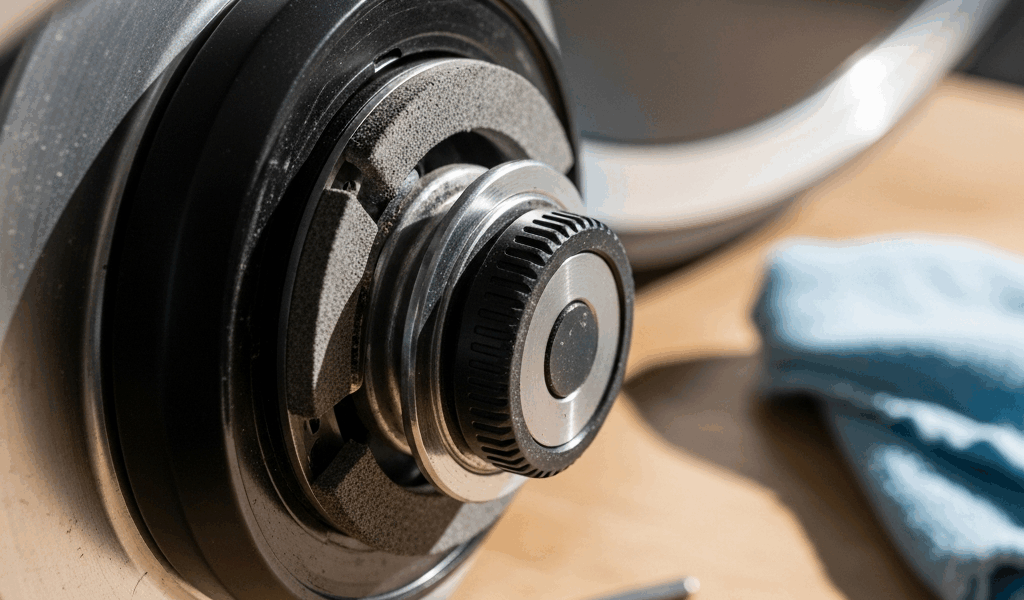
Friction bikes press a felt brake pad directly against a spinning metal flywheel. Tighten the knob, the pad grips harder. Loosen it, the pad backs off. Simple, physical, old-school. Peek inside near the flywheel and you’ll spot the brake pad assembly — usually a small rectangular or curved piece of dark felt. A resistance cable runs from your knob straight down to that mechanism.
Common bikes running friction systems: older Peloton models, most budget bikes under $300, and a surprising number of commercial gym units collecting dust in the corner.
Magnetic Resistance — The Magnet System
Magnetic bikes use permanent magnets or electromagnets sitting near the flywheel. Adjusting resistance moves those magnets closer or farther away — no physical contact with the flywheel at all. The wheel spins freely every single time.
Telltale signs: heavier resistance knob, cleaner overall design, any kind of electronics involved. Newer Pelotons, the Bowflex C6, most smart bikes with Bluetooth or app connectivity. If your bike talks to a phone, it’s magnetic. Full stop.
Quick visual test — turn resistance all the way down and spin the flywheel. Friction bikes spin freely and make a soft scraping noise. Magnetic bikes spin freely but run noticeably quieter. Probably should have opened with this section, honestly. It changes every single step that follows.
So, without further ado, let’s dive in.
Friction Resistance Problems and How to Fix Them
Friction systems break in predictable ways. That’s what makes friction bikes endearing to us budget-conscious riders — the failures are readable and cheap to fix.
The Felt Pad Is Worn or Glazed
This is the most common failure by a wide margin. The felt pad compresses and hardens with heavy use — glaze sets in, grip disappears, and suddenly your resistance caps out at maybe 70% of what it used to feel like even when the knob is cranked tight. No grinding. No drama. Just… nothing.
The fix: replace the brake pad. Most friction pads run $15 to $40. Unscrew the brake pad assembly — usually two to four bolts — slide the old pad out, slide the new one in, bolt it back. Hand-tight plus a quarter turn is safe for most bikes. A Schwinn IC2 pad runs about $18. A Sunny Health & Fitness equivalent is closer to $12. Don’t make my mistake of buying the wrong pad because you skipped checking the model number first — there are at least four different Sunny pad sizes.
The Resistance Knob Is Stripped or Spins Freely
If the knob just spins and spins without any resistance change — no tension, no feedback — the internal nut has loosened or the threads are stripped.
The fix: remove the knob counterclockwise. Inside, you’ll almost certainly find a loose nut. Usually 8mm or 10mm. Tighten it. If it’s already tight and the knob still freewheels, the threads are stripped — you need a new knob assembly, which runs $25 to $60 depending on the brand.
The Resistance Cable Is Slack or Snapped
Frustrated by a resistance system that felt completely dead one afternoon, I finally traced the cable by hand and found it had simply unseated from its housing clip. Two minutes. No parts needed.
Trace the cable from the knob down to the brake pad assembly. Visible slack means it came loose. Kinking or fraying means it snapped.
The fix: slack cable gets rethreaded into its housing — reseat any clips that popped loose. Snapped cable needs full replacement. Universal cables work for many bikes, but brand-specific ones exist too. Budget $20 to $50, and check your model number before ordering.
The Brake Pad Contact Is Misaligned
Sometimes the pad assembly shifts just enough that it no longer sits flat against the flywheel. Resistance feels uneven — stronger on one side, weak on the other.
The fix: loosen the brake pad bolts slightly, reposition the assembly until the pad sits centered and flat, then retighten gradually while testing by hand. Ten minutes. Zero dollars.
Magnetic Resistance Problems and How to Fix Them
Magnetic systems add an electronics layer — which means there are more places for things to quietly fail on you.
The Resistance Cable Is Slack or Snapped
Yes, some magnetic bikes still run cables. The cable connects the knob to a mechanical arm that physically shifts the magnet housing toward or away from the flywheel.
The fix: identical to friction bikes — trace it, reseat it, or replace it. Cost lands between $20 and $50.
The Magnet Housing Has Shifted
The magnet assembly can drift out of position when mounting bolts loosen over time — vibration from heavy sessions is usually the culprit. When it shifts, the magnetic field weakens even at maximum resistance settings.
The fix: open the frame — typically four to six bolts — and inspect the housing. Tighten anything loose. Make sure the housing isn’t actually touching the flywheel. If a bolt is stripped, a slightly oversized replacement bolt or a threaded insert ($5 to $10 at any hardware store) sorts it out.
The Electronic Console Isn’t Registering Resistance
The knob physically moves. The display does nothing. Resistance feels random or stuck. This one shows up constantly on smart bikes running app-based control.
The mechanical fix first: trace the cable connection between the resistance knob and the main control board. Unplug it, wipe both ends with a dry cloth, reseat it firmly. Nine times out of ten — honestly, probably more like nine and a half — that’s the whole problem.
The electronic fix: unplug the bike entirely, wait 30 seconds, plug it back in, let it boot fully. If resistance still won’t register after that, the control board or sensor is likely faulty. That’s a warranty call, not a DIY afternoon project.
Quick Checks Before You Call It Broken
- Tighten the resistance knob nut: A loose retaining nut is the fastest culprit there is. Use a wrench on the underside while turning the knob counterclockwise to expose it.
- Wipe corrosion from contact points: Sweat and salt corrode metal fast — especially where the cable meets the housing. A dry cloth works for light buildup. For heavier corrosion, use 220-grit sandpaper lightly, then apply a thin coat of silicone lubricant.
- Reseat the resistance cable: Pop the cable out of its housing clips and slide it back in until you hear or feel it click. Most clips snap clearly into place — if you’re not sure it seated, it probably didn’t.
- Spin the flywheel with resistance zeroed out: It should move freely. If it doesn’t, you’ve got mechanical binding — look for debris near the brake pad or a bent pad assembly, not a resistance adjustment issue.
When to Replace Parts vs Replace the Bike
Felt pads and cables — cheap. A full magnet housing assembly — different conversation entirely.
The rule I use: if the repair costs less than 25% of the bike’s original purchase price, fix it. A $30 brake pad on a $200 bike is an obvious yes. A $150 magnet housing replacement on a $180 budget bike is an obvious no — put that money toward something new.
I’m apparently hard on felt pads and the Sunny Health & Fitness $12 pad works for me while the generic Amazon equivalent never holds tension past three months. Don’t make my mistake buying the cheapest possible part when a brand-matched replacement costs $6 more and lasts twice as long.
Most resistance problems land squarely in the fixable zone. Worn felt pad — normal, cheap. Loose cable — same story. Stripped knob nut — 20 minutes and a wrench. You’re realistically looking at $15 to $60 and half an hour of your time for the vast majority of failures.
You’ve got this. The diagnosis is straightforward once you know which system you’re working with — and now you do.

Leave a Reply