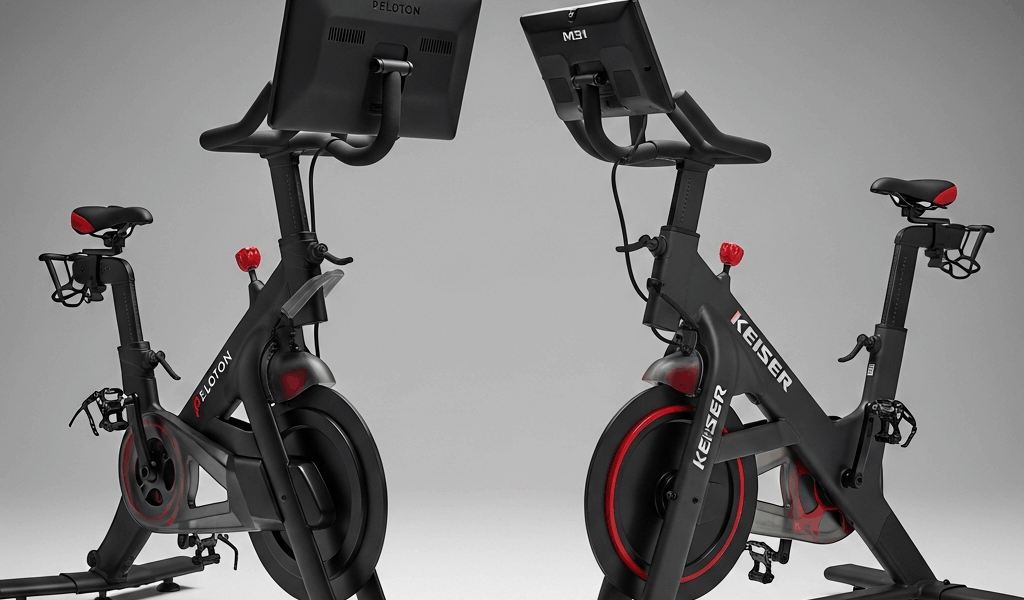
Peloton vs Keiser M3i — Which Indoor Bike Is Worth the Money?
Indoor cycling has gotten complicated with all the marketing noise flying around. Two bikes. Both expensive. Both with passionate defenders who think the other side is lighting money on fire. I’ve owned a Keiser M3i for three years and used a Peloton regularly at a friend’s place for nearly two of those years — so I’ve got something most comparison pieces don’t: actual side-by-side experience, not spec sheet tourism. Here’s what I figured out eventually: these bikes aren’t really competing. They’re solving completely different problems. Once that clicked, the whole debate stopped being confusing.
The Fundamental Difference
But what is Peloton, really? In essence, it’s a content platform that sells hardware to lock you into a subscription. But it’s much more than that — and understanding that changes every other decision you’ll make here.
Peloton sells you the Bike ($1,445) or the Bike+ ($2,495), then needs you paying $44 a month for the All-Access Membership — ideally forever. The screen, the camera, the Bluetooth speakers, the live leaderboard — all of it exists to make canceling feel unthinkable. And honestly? For a lot of people, it works. The classes are genuinely good. The instructors are genuinely motivating. The community is genuinely real.
Keiser came at this from the opposite direction entirely. The M3i was engineered for commercial cycling studios — the kind of place that needs a bike to survive ten years of daily punishment by hundreds of different riders. It connects to Bluetooth and ANT+ simultaneously, meaning it talks to your phone, your Apple Watch, Zwift on your laptop, and a heart rate monitor all at once. No Keiser subscription. No required Keiser app. Pair it with whatever you want — Peloton’s own app, Zwift, Apple Fitness+, TrainingPeaks, Strava — and go ride.
That’s what makes this distinction endearing to cyclists who’ve been around long enough to see the difference. If you need a coach on screen to push through a 45-minute ride, Peloton was built for you. If you have a training plan and need accurate wattage data to execute it, Keiser was built for you. Most comparison articles try to crown a winner. The smarter question is which category you actually fall into.
Build Quality and Durability
Frustrated by overcrowded boutique studio classes, I ended up stumbling into a commercial cycling studio in 2019 — and I mean literally stumbling, tripped over a spin shoe because the room was packed — and noticed every single bike in the row was a Keiser M3i. Not Pelotons. Not SoulCycle’s branded Stages bikes. Keisers. Asked the instructor afterward. She said something I’ve repeated probably fifty times since: “These bikes don’t die.”
The M3i retails around $2,295 depending on where you buy it. That price includes a rear-mounted magnetic flywheel — bigger deal than it sounds. On most indoor bikes, Peloton included, the flywheel sits between your legs or up front, directly in the splash zone for sweat. Sweat is corrosive. Over years it degrades mechanical components in ways that aren’t obvious until something actually fails. Keiser moved the flywheel to the back of the bike specifically to address this. Walk into any gym that’s had M3i units for five-plus years and look at the condition of those bikes. They hold up.
Weight capacity difference matters too. Keiser supports riders up to 350 lbs. Peloton’s limit is 297 lbs. That 53-pound gap is irrelevant to some riders and everything to others — but it also tells you something about the structural engineering philosophy of each bike. Keiser was spec’d for the broadest possible commercial user base.
Peloton makes a well-built consumer product — not cheap feeling at all. The 21.5-inch touchscreen on the original Bike is solid; the 23.8-inch rotating screen on the Bike+ is genuinely impressive. Real build quality. But Peloton is designed to last as long as the subscription makes sense — roughly five to eight years for a well-maintained home unit with one or two regular riders. The M3i is designed to last fifteen-plus years in a commercial environment with dozens of daily riders.
Don’t make my mistake — I assumed the Peloton’s heavier flywheel (38 lbs vs. the Keiser’s 8 lb magnetic flywheel) meant it was more durable. It’s actually just a different mechanism. Keiser’s magnetic resistance has fewer moving parts that can wear out. Resistance on the M3i is created by magnets moving closer to or further from the flywheel — nothing ever touches, nothing wears from friction. I’ve adjusted the resistance on my M3i probably ten thousand times over three years. The feel is identical to day one.
The Content Question
Probably should have opened with this section, honestly — because for most buyers, content is the entire decision.
Peloton’s All-Access Membership is $44 per month. That’s $528 per year — $1,584 over three years. Add that to the Bike’s $1,445 purchase price and you’re at $3,029 for a three-year total cost of ownership, before delivery ($250), accessories (shoes run $125-$150, heart rate monitor is another $65), or any service calls. The Bike+ three-year ownership cost climbs past $4,500 without breaking a sweat.
Here’s the detail most people don’t know: Peloton’s App Membership — classes without the hardware — is $12.99 per month. You can pair that $12.99 subscription with a Keiser M3i and get Peloton classes on your phone or tablet while the M3i broadcasts accurate power data to the app. You get the instructors, the music, the structure — and real wattage numbers underneath it all. Serious cyclists use this setup regularly. It’s completely legitimate.
Keiser’s three-year cost is just the bike: $2,295, plus whatever apps you choose. Zwift runs $14.99 per month ($539.64 over three years). Apple Fitness+ is $9.99 per month ($359.64 over three years). Even with a premium subscription stacked on, the Keiser three-year total stays competitive with — or beats — the Peloton ecosystem, depending on what you’re running.
Raw cost comparison undersells what Peloton’s content actually delivers, though. The live class experience — 6 AM rides with hundreds of other people on the leaderboard, instructors calling out your username when you’re near the top, the specific culture built around Alex Toussaint and Robin Arzón — that isn’t something you replicate with the app membership alone. The All-Access experience is the full product. If that environment is what gets you out of bed and onto the bike at 5:45 AM on a Tuesday, $44 a month is probably worth every cent.
Zwift has built something comparably immersive for cyclists who want virtual racing and structured training — different vibe than Peloton, not inferior. Just different.
Power Accuracy
This section matters more than most people realize, and less than some cycling snobs claim. Both things are true.
The Keiser M3i has a power meter accurate to plus or minus one percent. One percent — the same accuracy spec as a Quarq DZero power meter that road cyclists spend $700-$900 on for outdoor bikes. When your Keiser reads 220 watts, you’re actually producing somewhere between 217.8 and 222.2 watts. Tight enough to build a serious training program around, compare results across weeks and months, and know that when your FTP climbs from 235 to 248 watts, that improvement is real.
Peloton’s power measurement is more complicated. The bike estimates power based on flywheel speed and resistance settings — and calibration varies between individual bikes, sometimes varying on the same bike over time as components wear. There are well-documented threads on r/pelotoncycle (over 300,000 members) from riders who tested identical workouts on multiple Peloton bikes and got wildly different output numbers. A 300-watt effort on one Peloton might read 265 watts on another. Newer bikes are better calibrated than older ones, apparently, but the fundamental architecture of the power estimation is less precise than a dedicated power meter.
For casual riders doing a 30-minute feel-good ride three times a week, this genuinely doesn’t matter. Not tracking FTP, not following a periodized training plan, not comparing power-to-weight ratios — the Peloton’s output numbers work fine as a relative effort measure on your own specific bike.
For cyclists training with actual purpose — working toward an event, following a structured plan from TrainingPeaks or Today’s Plan, doing threshold or VO2 max work — inaccurate power data is a real problem. Bad data produces bad training decisions. You can’t trust a number that shifts depending on which bike you happen to be riding that day.
The mistake I made in my first year with the M3i was ignoring the power data anyway. Years of gym cycling had me riding by feel — RPE all the way. Took about six months before I started using the wattage numbers in a structured way. The six months after that? Fitness gains noticeably faster. Accurate data, used consistently, changes how you train. I left real progress on the table by ignoring it. Don’t do that.
Who Should Buy Which
Cut through everything above and the decision comes down to what kind of rider you actually are.
Buy the Peloton If—
You need external motivation to stay consistent. That’s not a character flaw — it’s honest self-knowledge. Some people will ride three times a week for years because an engaging instructor with a curated playlist made it feel like an event rather than exercise. The leaderboard, the high-five system, the milestone badges, the live classes with real-time participation — Peloton has invested enormous resources into making you feel like you’re part of something. That’s worth $44 a month for the right person.
Also consider Peloton if you’re sharing the bike with a partner or family member who responds differently to workouts. The class variety is genuinely broad — 20-minute low-impact rides, 45-minute HIIT sessions, beginner programs, cycling-specific endurance work, themed rides built around specific artists or decades. If one household member wants instructor motivation and another wants structured training, Peloton’s library covers more ground than almost anything else out there.
Buy the Keiser M3i If—
You have a training goal that requires accurate data. Cyclists coming off outdoor riding who want to maintain or build fitness indoors. Triathletes doing base training through winter. Riders following a coach’s program. Anyone who has ever used a power meter outdoors and understands what that data actually tells you. The M3i is the tool for this use case — and nothing in the consumer market touches it for that specific purpose.
Also consider Keiser if you’re buying a bike you plan to use for the next ten to fifteen years. The commercial-grade construction makes a genuine long-term ownership difference. Zero mechanical issues in three years of regular use on mine. I know people who’ve owned M3i units for eight years — same story. That kind of reliability changes the math on the higher upfront price considerably.
Consider Neither If—
Your budget is under $1,500. Both of these bikes are premium products — neither should be purchased reluctantly or under financial strain. The Schwinn IC4 ($799-$999) connects to Peloton’s app, Zwift, and Apple Fitness+ via Bluetooth, supports riders up to 330 lbs, and offers a genuinely solid ride. It’s not a Keiser. The power data is less accurate and the build is lighter. But it gets you on a bike, connected to content you’ll actually use, without overextending.
The NordicTrack S22i ($1,299-$1,499) is another legitimate option in this range — large touchscreen, iFit content included for the first year, automatic resistance adjustment that syncs with instructor commands. Different ecosystem, genuinely capable machine.
Spending $1,500 on a bike you can’t comfortably afford breeds resentment toward the bike. That’s not a setup for consistent riding.
The Bottom Line
After three years on the Keiser and two years of regular Peloton access, here’s my honest take: the Peloton is a better product for more people. The content ecosystem, the community, the motivation layer — they solve the real problem most people have with home fitness, which is staying consistent. Most riders aren’t training for anything specific. They want to get healthier, feel better, and not dread their workouts on a Wednesday morning. Peloton is extremely good at solving exactly that problem.
The Keiser M3i might be the best option for a specific kind of person, as serious indoor training requires accurate, reliable power data. That is because bad numbers produce bad training decisions — and the M3i is the only consumer bike that eliminates that variable entirely. If that person is you — if you care about accurate power data, want a bike that outlasts every other piece of equipment in your home gym, and want the freedom to connect to any platform without ecosystem lock-in — the M3i is the right answer. The price premium over five or ten years becomes negligible.
These two bikes are not really competing. Decide which problem you’re actually trying to solve. Then the choice is obvious.


Leave a Reply