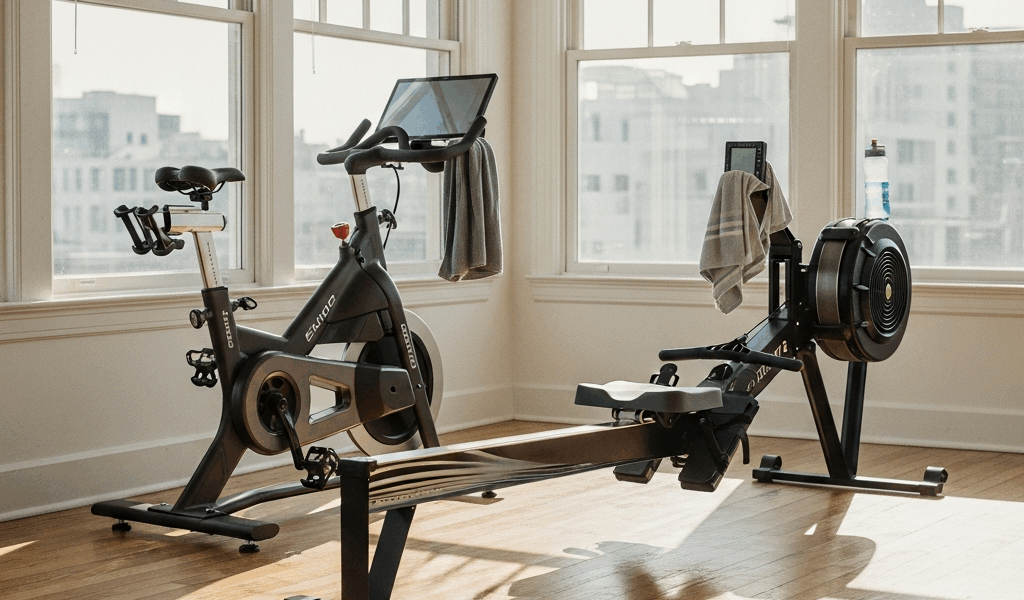
Spin Bike vs Rowing Machine — Which Burns More Calories?
The spin bike vs rowing machine debate has gotten complicated with all the conflicting fitness advice flying around. As someone who spent eighteen months actually owning and testing both machines in a basement home gym, I learned everything there is to know about this particular comparison. Today, I will share it all with you.
It started with a corner of my basement, a $1,200 budget, and exactly enough room for one machine. Not two. One. So I did what any reasonable person does — I became obsessed with spreadsheets, Reddit threads, and eventually just bought both over eighteen months to test them myself. Here’s what I actually found.
Calorie Burn Comparison — The Numbers
Raw data first. Rowing machines put most people somewhere between 400 and 600 calories per hour. Spin bikes shift that range up to roughly 400 to 700 calories per hour. The spin bike edges ahead — but only at high intensity. Back off the resistance and that gap closes fast.
Those numbers carry serious asterisks. Body weight matters enormously — a 180-pound person burns meaningfully more than a 130-pound person running the same machine at identical effort. Duration compounds everything. Intensity is probably the biggest variable of all. A casual 45-minute spin session at conversational pace gets smoked by a hard 30-minute rowing interval workout, calorie-for-calorie.
Here’s something concrete. I wore a Polar H10 chest strap during workouts on my Concept2 Model D rower and my Schwinn IC4 spin bike for three straight weeks. My average rowing session — 45 minutes, moderate effort — came in around 480 calories. My average spin session at similar perceived effort hit about 510. When I pushed the IC4 hard, standing climbs and high-cadence intervals, sessions ran 620 to 650 calories. My hardest rowing sessions topped out around 560.
The spin bike ceiling is higher. That’s real. But most people don’t live at the ceiling.
What Affects Your Burn Most
- Body weight — heavier riders burn more on both machines
- Workout intensity — interval training spikes calorie burn on either machine
- Duration — the rower tends to fatigue people faster, which cuts sessions short
- Fitness level — conditioned athletes burn fewer calories at the same absolute effort
Full Body vs Lower Body — The Real Difference
Here’s what most calorie comparisons skip entirely — and it’s probably more important than any number above. Rowing engages roughly 86 percent of your muscle mass. Legs, back, arms, core — everything fires in sequence on every single stroke. The spin bike is primarily a lower body machine. Quads, hamstrings, glutes, some core stabilization. Your arms are basically just resting on the handlebars.
More muscle recruitment means more total work performed. More metabolic demand during the workout and after it. Rowing builds that post-workout calorie burn more effectively. Spin bikes let you push leg output harder and faster — that’s why peak calorie numbers skew higher — but the muscle engagement story favors the rower for overall body composition work. That’s what makes rowing so endearing to us fitness obsessives who hate buying multiple machines.
Honestly, this is where the decision should live for most people. Not in a 50-calorie-per-hour difference. In what kind of fitness you’re actually building. I noticed real changes in my back and arm definition after three months of consistent rowing — changes that four spin rides a week never delivered, not even close.
Training for a specific sport, or already doing heavy lifting and just want pure cardio output? Spin makes sense. Want a single machine that genuinely does everything? Rowing is hard to beat.
Joint Impact and Injury Risk
Both machines are low-impact. Neither pounds your joints the way running does. But low-impact doesn’t mean zero-risk — at least if you skip the setup work — and I learned this the hard way.
Dragged into the rower too aggressively after watching a handful of YouTube tutorials, I pulled something in my lumbar spine around week three of owning the Concept2. Sat out five days. The rowing stroke looks deceptively simple but punishes poor form — specifically the early arm pull and the collapsed lower back at the catch position. The learning curve is real. Don’t make my mistake.
Spin bikes carry their own risk, mostly in the knees. Saddle height is everything. Too low and you’re grinding your patellar tendon on every pedal stroke. I ran my IC4 saddle at position 4 instead of position 6 for my 5’11” frame during the first two weeks, and my left knee made its feelings very clear. A proper bike fit, even a self-guided one using the heel-on-pedal method, eliminates most of that risk immediately.
Neither machine is inherently dangerous. Both reward setup and technique. The rower has a steeper form learning curve. The spin bike is more forgiving once saddle height is dialed in.
Space, Noise, and Practical Considerations
Probably should have opened with this section, honestly. I’ve watched beautiful home gyms turn into expensive coat racks because the machine didn’t fit the actual living situation.
Rowing machines fold. The Concept2 Model D — retails around $900 — folds in half and rolls on caster wheels to stand upright against a wall or inside a closet. Stored footprint is roughly 25 by 33 inches. That’s genuinely apartment-friendly. When it’s out for use, though, you need about 9 feet of floor length. Catches people off guard every time.
Spin bikes don’t fold. The Schwinn IC4 sits at about 48 inches long by 21 inches wide permanently, wherever you park it. Not a dealbreaker for most people. But worth knowing before you measure twice and buy once.
Noise is where spin bikes win decisively for apartment living. I’m apparently a late-night workout person, and the IC4’s magnetic resistance system works for me while the Concept2’s chain drive never really fits that 11pm slot. The IC4 is nearly silent. The Concept2 creates a consistent whooshing mechanical sound — not loud by gym standards, absolutely audible through walls and floors.
Maintenance comparison is simple. Spin bikes need occasional flywheel bolt checks and brake pad inspection, or none at all on magnetic models. Rowers need periodic chain lubrication — about two drops of mineral oil every 50 hours of use on the Concept2. Neither is demanding.
Our Verdict — Which to Buy
So, without further ado, let’s dive in. Here it is, without hedging.
For weight loss — buy the spin bike. The higher peak calorie ceiling is real. High-intensity interval training on a spin bike is accessible, easy to program, and genuinely brutal in the best way. Platforms like Zwift or Peloton’s app — which works with the IC4 via Bluetooth — make it easy to stay consistent, and consistency is what actually drives fat loss over time. The spin bike asks less of your technique, so you can push harder sooner.
For full-body fitness and long-term health — buy the rower. No other single piece of cardio equipment builds your back, improves posture, develops arm strength, and delivers serious cardiovascular conditioning simultaneously. The calorie burn is close enough to the spin bike that it doesn’t matter in practice. What matters is training your entire body instead of just your legs.
A few quick decision rules if you’re still on the fence:
- You live in an apartment with noise restrictions — spin bike
- You have existing knee problems — rowing machine
- You have existing lower back problems — spin bike (until back is strong)
- You want to pair with strength training that already covers upper body — spin bike
- You want one machine to replace a full gym — rowing machine
- Budget is under $600 — spin bikes have better options at that price point
I kept both machines. The rower gets used four days a week. The spin bike comes out for late-night sessions when I can’t afford to wake anyone up. If I had to choose one to keep and sell the other tomorrow, I’d keep the Concept2 — the full-body training effect is too valuable to surrender over a 100-calorie-per-hour difference that only appears when you’re going absolutely all-out anyway.
Buy based on your actual fitness goal. The calorie difference is real but smaller than the marketing suggests. The muscle engagement difference is real and larger than most people realize.

Leave a Reply