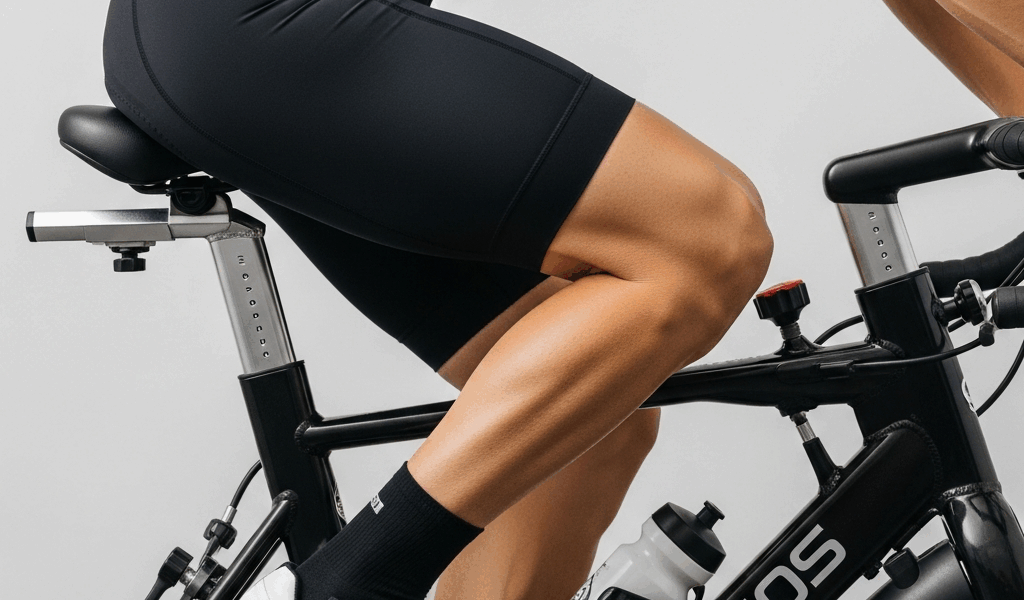
How to Tell If Your Seat Is Actually Too High
Spin bike seat height has gotten complicated with all the conflicting advice flying around. As someone who spent three months riding with a saddle positioned way too high, I learned everything there is to know about what bad fit actually feels like. Today, I will share it all with you.
Your hips rock side to side — that’s the big one. Film yourself from the side for 30 seconds, or watch your lower body in a mirror while you pedal. If your hip dips down on one side with each stroke, like your torso is doing some subtle shimmy, your pelvis is compensating for an overextended leg. That shouldn’t happen. Ever. Hips should stay level and stable throughout the entire pedal circle.
You point your toes to reach the bottom. At the 6 o’clock position, your foot shouldn’t have to flex downward like you’re auditioning for ballet just to complete the stroke. Constantly plantarflexing — pointing your toes — to make contact with the pedal at the bottom? Seat is too high. Full stop.
Your knees hurt behind the kneecap. Not the satisfying soreness from a hard class. A dull, persistent ache that shows up mid-ride or lingers for two or three hours afterward. The patella sits in a groove at the end of your femur, and when your leg overextends at the bottom of each stroke, that joint gets compressed in exactly the wrong way.
Your lower back aches after short rides. Twenty minutes in and your lumbar spine already feels fatigued. Your core is working overtime to stabilize all that rocking motion happening at your hips. That’s the chain reaction a too-high saddle starts.
Power just drops off at the bottom of the stroke. Dead spot. You can push through the top of the circle fine, but the bottom feels weak and disconnected. That’s overextension killing your leverage — and it’s fixable in about five minutes.
Why Seat Height Matters More Than You Think
But what is “too high,” really? In essence, it’s any position where your leg straightens too much at the bottom of the stroke. But it’s much more than that. When the leg overextends, the hip dips to compensate, the knee tracks poorly through that extended range, and stress piles onto the patellar tendon and the IT band — that thick strip of tissue running down the outside of your thigh.
That’s what makes proper fit so important to us regular riders. We’re not pros with coaches watching every pedal stroke. We’re just people trying to get a good workout without destroying our knees. Ride with a bad seat height long enough and you get real injury. IT band syndrome. Patellofemoral pain syndrome. Things that stick around for six to eight weeks minimum. You don’t want that.
The Quick Way to Find Your Correct Seat Height
So, without further ado, let’s dive in. There’s a landmark trick that works across almost every spin bike model — Peloton, Echelon, NordicTrack, whatever’s sitting in your living room.
Stand next to your bike. Adjust the seat so the top surface lines up with your hip bone — specifically your ASIS, the pointy bit of your pelvis at the front of your hip. That’s your starting point, not your final answer.
Now clip in and rotate one foot to the 6 o’clock position. Your knee should have a slight bend. Not locked straight. Not crunched at 90 degrees. Somewhere in the 25–35 degree range — if you have a goniometer lying around, great, but honestly eyeballing it works fine once you know what you’re looking for. Straight-legged means too high. Knee looks crunched means too low.
Here’s what most guides skip entirely: test it for five minutes first. Once your muscles warm up, your body position shifts slightly. Recheck that knee angle after a short warm-up. You might need to tweak it by half an inch — sometimes less.
Peloton and Echelon bikes use a pop-pin system. Pull the lever, slide the post, done. NordicTrack and a few other stationary bikes use a bolt clamp — usually a 4mm or 5mm Allen wrench. The mechanism differs. The target height doesn’t.
How to Adjust the Seat on Your Spin Bike
Stop pedaling. Get off the bike.
Find the seat post clamp — it’s usually underneath the saddle or on the vertical post directly below it. Loosen it. Don’t yank it completely off, just enough that the post can slide. Bolt-style clamps typically need three or four counterclockwise rotations with your Allen key.
Move the seat down in small increments. One notch. Maybe one inch. Not a dramatic drop. Small changes let you dial it in instead of overcorrecting and spending another 20 minutes readjusting.
Re-tighten immediately — at least if you want to avoid what happened to me. I’m apparently someone who forgets to fully lock down the seat post, and my Peloton works fine right until I’m mid-ride in a live class and the seat slips toward the floor. Don’t make my mistake. Push that lever down firmly, or torque that bolt until it’s snug. A loose seat post is genuinely dangerous.
Test for 30 seconds at easy resistance. Spin gently. Watch your hips. Feel the knee angle at the bottom of the stroke. Still off? Get off, adjust again. This part is tedious but worth every minute.
Still Getting Pain After Adjusting Your Seat Height
Most riders fix the problem in one adjustment. But if you’ve lowered the seat and still feel hip rock or knee discomfort, the seat height probably wasn’t the only issue.
Fore-aft position might be the best option to check next, as spin bike fit requires getting horizontal placement right too. That is because a saddle pushed too far toward the rear forces your weight forward and creates the same hip-rocking pattern even at the correct height. Try sliding it forward about an inch and retesting. Your knee should track directly over your toe at the 3 o’clock and 9 o’clock positions.
Saddle tilt. Probably should have opened with this section, honestly. If the nose of your saddle angles too far downward, you slide forward with every stroke — which causes excessive hip motion just like a too-high seat does. Keep the saddle level or tilted very slightly nose-down, maybe 2–3 degrees maximum.
Cleat alignment. If you’re riding with clip-in shoes and cleats are even slightly rotated inward or outward from your natural foot angle, your knee tracking gets thrown off. Check that your cleats sit where your foot lands naturally — not twisted, not forced.
You might also benefit from looking at our guides on spin bike seat pain solutions and cleat compatibility and setup for deeper troubleshooting.
Most riders feel relief the moment they lower a too-high seat. That was 1996 — wait, no. That’s every day in gyms and home setups everywhere. You’ve already done the hardest part: noticing something is wrong. The fix takes minutes. Get adjusted, warm up properly, and ride without that nagging pain behind your knee. That’s the whole goal.

Leave a Reply