Why Cleat Compatibility Trips Up So Many Riders
Spin bike cleat compatibility has gotten complicated with all the conflicting advice flying around. You buy a bike. You buy shoes. Then you’re standing on your kitchen floor holding a shoe in one hand and a pedal in the other, genuinely baffled about why nothing clips together. I’ve been there — literally standing there at 10pm wondering what went wrong.
Here’s the ugly truth: spin bike manufacturers ship their bikes with one of two cleat standards, shoe brands manufacture for one or the other, and somehow neither company bothers to explain this clearly. The bike company’s website glosses over it. The shoe brand’s sizing guide never mentions it. So you end up Googling at midnight, frustrated and already $150 into a purchase that won’t work.
Grabbed what I thought were premium cycling shoes from a major brand, got home excited, and the cleats wouldn’t come anywhere close to fitting my new bike’s pedals. Probably should have opened with this section, honestly.
The good news: once you understand the two systems that actually matter for indoor cycling, this whole thing becomes trivial. SPD and Look Delta cleats. That’s it. Forget everything else you’ve read about cycling footwear standards. For spin bikes — not outdoor road cycling, not mountain bikes — these two are what matter.
The Two Cleat Systems That Actually Matter for Spin Bikes
SPD Cleats — The 2-Bolt Standard
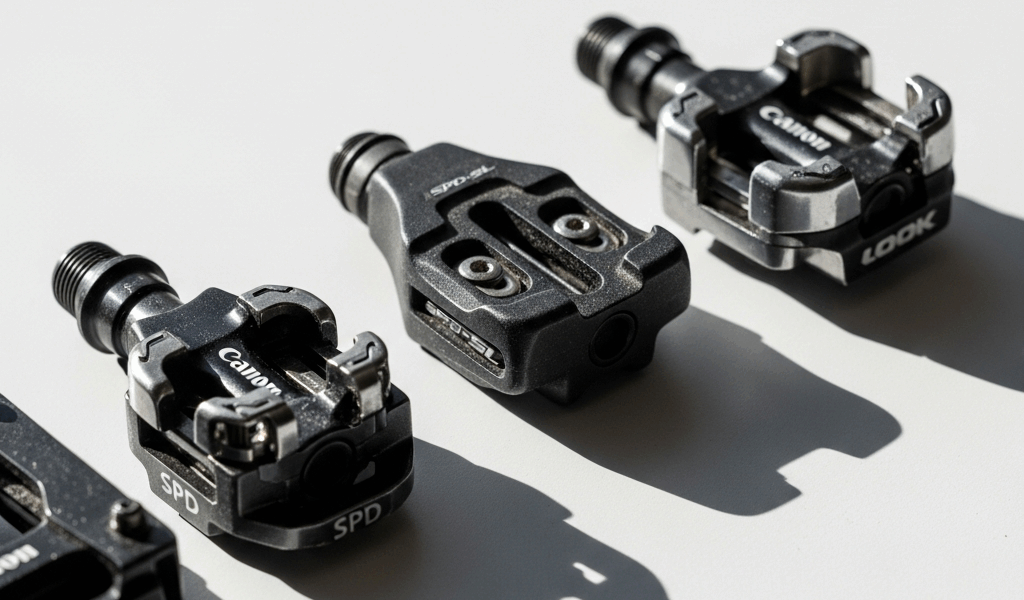
SPD stands for Shimano Pedaling Dynamics. Two bolts, spaced 4.5 millimeters apart. Small, recessed into the shoe sole, clipping into pedals via a spring-loaded mechanism. If your bike came with SPD pedals, you’ll spot a rectangular cleat pattern right on the pedal face.
Most budget and mid-range spin bikes default here. Brands like Sunny Health & Fitness, Stationary Bike Co., and generic gym-quality options almost always ship with SPD-compatible pedals. That’s just the reality of that price range.
The real advantage — and this is what makes SPD endearing to us indoor riders who occasionally venture outside — is that these shoes genuinely work for both indoor and outdoor cycling. Clip into your spin bike on Tuesday, ride outside on Saturday. The cleats sit flush against the sole, so walking around doesn’t feel like you’re crossing a tile floor wearing ice skates.
Look Delta Cleats — The 3-Bolt Standard
But what is Look Delta? In essence, it’s a three-bolt system arranged in a triangular pattern. But it’s much more than that — it’s also the reason countless Peloton buyers end up confused at a bike shop.
Peloton uses Look Delta exclusively. So does Equinox’s Bowflex C7 and several other premium indoor cycling brands. If you own a Peloton or bought their official shoes, congratulations — you have Look Delta cleats, whether you knew it or not.
The cleats are larger, more rigid, and clip into a wider pedal platform. That wider platform offers a stable, planted feel during seated cycling. The trade-off is that these cleats protrude further from the sole, making walking genuinely awkward. Most riders who buy Look Delta equipment never really take their shoes anywhere anyway — they live on the bike.
Quick Compatibility Matrix
- SPD pedals: Accept only 2-bolt SPD cleats. Most compatible shoes run $60–$140.
- Look Delta pedals: Accept only 3-bolt Look Delta cleats. Shoes range from $80 up past $250.
- Caged or toe-clip pedals: Require nothing special. Any sneaker works. This is your free option — and a legitimate one.
- Dual-sided pedals: One side caged, one side with cleats. Perfect for beginners who aren’t ready to commit to clip-in cycling just yet.
Can you use shoes that accept both cleat types? Rarely. Some premium cycling shoes have dual-mounting capability, but they’re expensive and genuinely uncommon in the spin bike market. Most shoes are built for one system. Pick a lane.
How to Check What Pedals Your Spin Bike Has
So you already own the bike. The manual is lost — or worse, useless. How do you figure out what you’re actually working with?
Visual Inspection
Look directly at the pedal face. SPD pedals have a small rectangular contact zone — maybe 2 by 1 inch — with visible spring mechanisms on either side. Look Delta pedals are noticeably larger, roughly 4 by 3 inches, with three circular bolt points and a flat, stable platform that’s hard to miss once you know what you’re looking for.
If the pedal is just a flat cage with foot straps, that’s toe-clip. No cleat system at all. Regular sneakers work fine — no need to overthink it.
The Model Number Check
Search your bike’s model number on the manufacturer’s website or Amazon. Find the spec sheet — usually buried near the bottom under “drivetrain” or “accessories.” It will list pedal type explicitly. For Peloton, they use the phrase “Look Delta compatible pedals” in every single listing. Most other brands mention SPD or caged pedals just as clearly.
What Dual-Sided Pedals Mean for You
Some bikes ship with pedals that have a cage on one side and cleats on the other. This is beginner-friendly in a genuinely practical way. Ride in regular trainers while you figure out whether clip-in cycling is even for you. Once you’re ready, flip the pedal and clip in. Try it both ways before spending money on shoes — that’s the whole point of the design.
Matching Your Shoes to Your Bike Pedals
Now the actual decision. Which shoes do you need?
If Your Bike Has SPD Pedals
Buy any shoe labeled “SPD compatible” or “2-bolt cleats.” The Shimano ME2 runs around $90 and holds up well. Pearl Izumi sits in the mid-range at $100–$140. Giro’s entry-level options land between $80 and $120. I’m apparently a mid-range buyer and Pearl Izumi works for me while budget options never quite fit right — but your feet are different from mine.
Don’t make my mistake: check that the product description explicitly states “SPD 2-bolt cleat compatible.” Don’t assume based on brand name or shoe appearance alone.
If Your Bike Has Look Delta Pedals
You need Look Delta compatible shoes. Full stop. Peloton’s official shoes use this system and run $125–$200. Shimano, Giro, and Specialized also make Look Delta compatible options — just look for “3-bolt Look Delta compatible” in the listing.
Here’s the trap that catches people constantly: buying Peloton shoes for a non-Peloton bike that has SPD pedals. The shoes are Look Delta only. They physically will not fit. Check your pedal type first — before you buy anything.
The Trainer Workaround
Not ready to spend money on cycling shoes? Use regular athletic trainers with caged or toe-clip pedals. Most gym spin bikes use these pedals for exactly this reason. You lose some power transfer efficiency, sure, but you save roughly $100 and can start riding today. That trade-off is completely reasonable for a lot of people.
When to Upgrade Your Pedals Instead of Your Shoes
Here’s a scenario worth walking through: you already own quality SPD cycling shoes from a previous bike. Your new spin bike has Look Delta pedals. Do you buy new shoes or swap the pedals?
Swap the pedals. It’s cheaper and faster. That’s the whole answer.
Pedal Swapping Basics
Most spin bikes use standard 9/16-inch pedal threads — the universal cycling standard. Unscrew the original pedals, screw in SPD-compatible replacements. Ten minutes. You need a 15-millimeter wrench. Left pedal unscrews counterclockwise. Right pedal unscrews clockwise. Don’t mix those up.
Replacement SPD pedals run $40–$80 on Amazon or at a local bike shop. Check your bike’s specs before ordering — some older or imported models use different thread sizes, but honestly this is rare enough that it probably won’t apply to you.
When Swapping Makes Sense
You already own cycling shoes. The bike has incompatible pedals. Replacement pedals cost $50–$80. New shoes would be $100 or more. The math favors the swap — and you’re not locked into any brand ecosystem afterward. Swap the pedals, use your shoes, move on with your life.
When Buying New Shoes Makes Sense
Your bike came with quality pedals you’re happy with. You don’t own cycling shoes yet. In that case, buying shoes is genuinely simpler than swapping pedals — especially if you’ve never done it before. Just confirm the shoes match your pedal system before clicking purchase.
So, without further ado, let’s put this simply: check the pedals, match the shoes, clip in, ride. Cleat compatibility stops being confusing the moment you know which system you’re working with. That’s the only thing standing between you and getting on the bike.


Leave a Reply