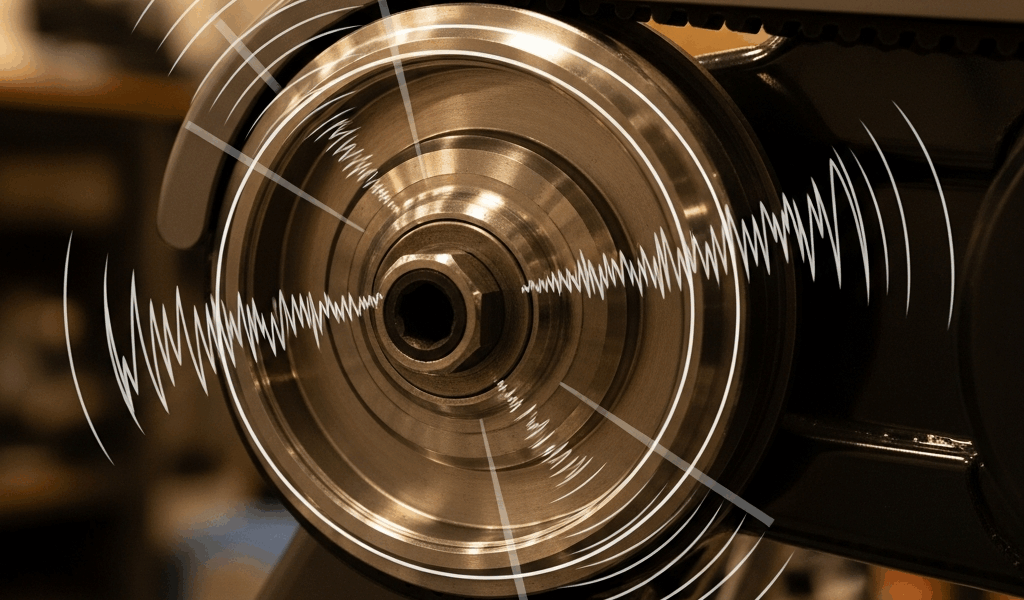
A clicking, scraping, grinding, or rattling sound near a spin-bike flywheel does not prove the flywheel itself is damaged. Pedals, crank arms, covers, resistance pads, belts or chains, pulleys, fasteners, and axle bearings can all transmit sound into the same area. Isolate the sound before replacing parts or applying lubricant.
Stop riding first if you see these warning signs
- The flywheel or crank visibly wobbles.
- A pedal, crank arm, axle, or resistance assembly feels loose.
- The emergency brake does not stop the flywheel as described in the bike’s manual.
- You smell hot rubber or electrical insulation.
- A belt or chain is frayed, damaged, or leaving debris.
- A guard is rubbing, cracked, or exposing moving parts.
- The noise began after a fall, move, collision, or incorrect assembly.
Unplug a powered bike before inspection. Wait until the flywheel and pedals stop completely, keep fingers and clothing away from the drive system, and use the manufacturer’s emergency-stop procedure. Many indoor bikes do not freewheel, so the pedals can continue moving whenever the flywheel moves.
Spin-bike flywheel noise: quick diagnostic table
| Noise pattern | Check first | Possible next step |
|---|---|---|
| One click per pedal revolution | Pedals, crank fasteners, shoe cleats | Inspect and tighten only to the model’s specification |
| One click per flywheel revolution | Debris, cover contact, flywheel alignment | Stop if there is wobble or damage |
| Clicking only under load | Pedal threads, crank, belt or chain tension | Follow the model service procedure |
| Scrape that changes with resistance | Friction pad or magnetic-resistance mechanism | Use the exact model’s adjustment instructions |
| Rattle over bumps or at high cadence | Leveling feet, bottle holder, covers, loose hardware | Inspect accessible fasteners with the bike stopped |
| Grinding even when pedaled slowly by hand | Drive system or bearings | Stop use and contact support if isolation requires disassembly |
Step 1: determine whether the sound follows pedals or flywheel
With the bike stopped, inspect for loose or visibly damaged parts. If the manual permits a hand-rotation check, turn the pedals slowly and count the sound. A click once per pedal revolution points toward a pedal, crank arm, bottom bracket, or drive pulley. A click once per flywheel revolution points more toward the flywheel rim, cover, resistance mechanism, axle, or an object touching the wheel.
Manufacturer troubleshooting often starts by isolating components rather than guessing. Sunny Health & Fitness, for example, recommends checking pedal rotation, determining whether the noise remains with the cover removed, and then isolating crank, belt, and axle sources. Cover removal and belt removal are not universal owner tasks—stop at the point your model manual or warranty requires service.
Step 2: rule out external contact and loose accessories
Use a flashlight without placing hands near moving parts. Look for a cable, guard, trim piece, bottle cage, transport wheel, resistance-pad holder, or loose object contacting the flywheel or frame. Confirm that the bike sits level and does not rock. Check only user-accessible hardware identified in the owner’s manual.
Do not indiscriminately tighten every bolt. Some fasteners control flywheel alignment, belt tension, bearings, or magnetic-resistance calibration. Excess torque can damage threads, distort parts, or change alignment. If the manual specifies a torque value or sequence, use it; otherwise contact the manufacturer.
Step 3: inspect the pedals and crank connection
Pedal and crank noise frequently seems to come from the flywheel because the frame carries vibration. Check for side-to-side pedal play, a loose crank arm, damaged threads, or a shoe cleat contacting the pedal. Remember that left and right pedals commonly use different thread directions. Follow the bike manual before removing or reinstalling either pedal.
If the click occurs only when seated, only when standing, or only under heavy resistance, note that pattern for support. It helps distinguish a loaded crank or pedal connection from a wheel that makes noise while coasting.
Step 4: distinguish friction and magnetic resistance
A friction-resistance bike uses a pad that physically contacts the flywheel. A light rubbing sound may change as resistance changes, but contamination, uneven wear, misalignment, or a damaged pad can cause abnormal squealing or scraping. Use only the cleaning or pad-care product approved for that model.
A magnetic-resistance bike should not have a friction pad dragging on the flywheel. Scraping can indicate a guard, magnet carrier, or other component is out of position. Do not bend a magnet bracket or guess at a universal clearance; consult the model’s service instructions.
Do not spray general lubricant on the flywheel
Lubrication advice depends on the drive and resistance design. Some chain-driven models specify a particular chain lubricant. Some friction-pad models specify a product for the pad. Belt-driven and magnetic bikes can be damaged or made unsafe by lubricant in the wrong place. Indoor Cycling Group warns that spraying maintenance product directly onto the flywheel or pedal area can make a drive belt slip, reduce braking performance, or damage internal parts.
Do not inject bearing grease merely because a sound seems to come from the axle. Many bikes use sealed bearings, and a fitting or opening should never be assumed to be a grease port. Use the model service manual or manufacturer support.
Belt or chain clicking
A rhythmic sound that becomes faster with cadence can come from a belt, chain, pulley, sprocket, or tensioner. Look for visible dust, fraying, cracking, damaged teeth, corrosion, or uneven tracking only where the manual permits inspection. Do not operate the bike with a cover removed.
Belt and chain tension are model-specific. The Schwinn IC4/Bowflex C6 service manual, for example, provides a dedicated belt-tension procedure and classifies other flywheel and drive repairs separately. That is why a generic number of turns, belt deflection, or axle position is unsafe. Incorrect adjustment can cause noise, wear, poor resistance behavior, or warranty problems.
When bearings or axle damage are more likely
Possible bearing or axle symptoms include roughness through a full rotation, grinding that remains after external contact is excluded, lateral play, or a flywheel that no longer tracks consistently. Those symptoms still require model-specific diagnosis. A damaged pulley or bottom bracket can feel similar through the frame.
Stop riding if the wheel wobbles, binds, or has measurable play. Do not remove a heavy flywheel without the required support, tools, and service procedure. It can shift unexpectedly, damage sensors or magnets, and create a pinch hazard.
Information to collect before contacting support
- Brand, exact model, serial number, and purchase date
- Whether the bike is belt-, chain-, friction-, or magnetic-resistance
- Whether the sound follows pedal speed or flywheel speed
- Whether it occurs with zero, light, or heavy resistance
- Whether it occurs seated, standing, or while hand-rotating
- A short video showing the sound without placing the camera near moving parts
- Any recent assembly, move, fall, or maintenance
Check warranty terms before removing guards or drive components. Manufacturer support can use the model and symptom pattern to identify the correct inspection or part.
Frequently asked questions
Why does my spin-bike flywheel click once per rotation?
Look for something contacting the flywheel, a cover rubbing, an alignment problem, or an axle-related defect. First confirm that the click truly follows the flywheel rather than the pedals.
Can I keep riding if the noise is small?
Not until you rule out loose, rubbing, or damaged parts. Stop immediately for wobble, binding, heat or burning odor, damaged drive parts, loose pedals or cranks, or an ineffective emergency brake.
Should I lubricate a noisy flywheel?
Not generically. The correct maintenance depends on the exact brake and drive design. Applying the wrong product can contaminate a belt or brake surface and make the bike unsafe.
Why does the click happen only when pedaling hard?
Load-sensitive clicking often points toward pedals, crank arms, bottom bracket, drive pulley, belt, or chain rather than the flywheel rim itself. Record the pattern and follow the model’s troubleshooting sequence.
When should I call a technician?
Use manufacturer or qualified service when diagnosis requires flywheel removal, belt or chain tensioning, bearing replacement, resistance calibration, electrical work, or any procedure outside the owner’s manual.
Manufacturer sources
Use this guide to isolate a symptom, not to override the manual for your exact bike. Stop using damaged or unstable equipment until it is repaired.
If the flywheel noise is paired with a chain jump or loss of drive, follow the chain-versus-belt and alignment checklist.

Leave a Reply